
Compounding pharmacies require tight temperature, relative humidity, and pressurization control to operate in compliance with established standards. Updates that took effect in 2023 introduced changes that affect how these spaces are designed, operated, monitored, and certified.
Balancing and actively controlling the airflow to achieve the correct pressure relationships in compounding pharmacy spaces can be challenging. The HVAC systems must maintain accurate relationships and the differentials between the pharmacy and adjacent areas under everyday use, which can be problematic. These stringent requirements come from the many regulations governing compounding pharmacies’ construction, operation, and certification.
Besides the building codes in the specific jurisdiction, such as the International BuildingCodes (IBC), other organizations, like the Facility Guidelines Institute (FGI), United States Pharmacopeia (USP), and the Controlled Environment Testing Association (CETA), have requirements that must be adhered to for compliance.
FGI regulates all types of licensed healthcare buildings but references USP for additional requirements for compounding pharmacies. The USP is a non-profit organization comprising pharmacists who convene to review the requirements related to drugs and the protection of patients. From that convention, regulatory chapters are revised and distributed in the USP Compounding Compendium, a collection of documents to serve as a resource for compounding practitioners.
Portions of two chapters, particularly, relate to facility control for the building HVAC system: USP <797> and <800>. CETA governs the testing methods for maintaining the standards outlined in USP for sterile compounding facilities and the requirements for certification.
The sections below cover the key requirements and considerations discussed throughout this series:
Changes Coming Fall 2023
USP General Chapter <797> Pharmaceutical Compounding – Sterile Preparations was initially issued in 2019 but has been recalled and since revised, with an official enforcement date of November 1, 2023. USP General Chapter <800> Hazardous Drugs – Handling in Healthcare Settings was issued in 2019 but is informational only and not enforceable until USP <797> is officially adopted.
The current enforceable USP <797> is the 2008 version. Since USP <800> was not started until 2016, it is not referenced in the current official version of UPS <797>. Note that facilities will have a six-month grace period from when USP <797> is official to when UPS <800> will be enforceable.
USP <800> concerns handling hazardous drugs, so it is a protection measure for the pharmacists and health care staff, which makes it different from the USP <797>, which centers around the protection of the patients. These two chapters work hand in hand where the sterile compounding of hazardous drugs is concerned. In many jurisdictions, USP <800> will become effective this fall.
One of the main areas affected by these requirements is the HVAC system’s ability to maintain the pressure, temperature, and humidity conditions required within compounding spaces.
Pressure, Temperature, and Humidity

Compounding hazardous drugs is a chemically volatile process, which means that tight control of air pressure, temperature, and humidity is required. Thus, when designing compounding areas, it is critical to determine an acceptable time delay before alarming and when and how often to report these values when out of compliance.
Most mechanical systems are not capable of operating perfectly in all conditions due to many factors, including weather conditions, occupant demands, and maintenance, which affect the system’s operation and ability to provide consistent airflow and temperature. Heating, Ventilating, and Air Conditioning (HVAC) Systems can be designed to minimize this effect, often at a trade-off of added first cost for more complicated equipment.
Prior to the pending adoption of the latest version of United States Pharmacopeia (USP) <797> and <800>, it was adequate to periodically test the differential pressure manually and record it once daily. USP <797> and <800> now indicate that pressure differential monitoring must be performed continuously with a monitoring device, and then the results must be reviewed and documented at least once daily.
It should be noted that there is a difference between alarming and reporting: alarming concerns about non-compliance and reporting concerns about documenting that non-compliance.
In the strictest sense of the word, continuous alarming and reporting is impractical, as these spaces have occupants who move through interconnecting doors, compromising pressure relationships in the process, which causes inherent variations in the mechanical system delivering airflow.
Using more sophisticated control systems can reduce the impact of the mechanical fan system variation but not eliminate it entirely. The sophisticated controls come at a cost that is much more significant than a standard classroom or office building control system. In practical terms, there will be a range of acceptable operating pressures and a time delay to account for the fluctuations before an alarm indicates the system is out of compliance.
USP <797> and <800> do not give any guidance on a time delay that is acceptable prior to initiating an alarm. The Controlled Environmental Testing Association (CETA), which outlines a guide for the certification process of compounding facilities, also does not give a specific time delay prior to alarming compliance.
The set point and range of differential pressure must be discussed with the pharmacy and facility staff to determine the acceptable values above or below the required pressures before an alarm occurs. In addition, a time delay will also need to be discussed and documented in the facility’s standard operating procedures and reviewed as compounding operations continue.
A 5 to 15-minute delay of the pressures being out of range is generally a reasonable delay built into the monitoring system. While monitoring the differential pressures is continuous, the intent does not appear to be to maintain and document an exact pressure all the time but more to identify systemic errors if there are extended periods out of compliance.
A sterile hazardous drug compounding buffer room has a maximum differential pressure requirement in addition to the minimum for a sterile, non-hazardous buffer room. As USP <800> requires, the differential pressure must be between the range of negative 0.01 and negative 0.03 inches of water column.
Again, a discussion with the staff about a reasonable set point and delay until an alarm is set is a suitable means to avoid nuisance alarms that could delay or stop the safe operation of the pharmacy.
The USP <797> version that is being officially released November 1, 2023, allows manually recording the temperature and humidity values once a day but gives the users the option for a continuous recording device where results are retrievable. USP <797> indicates that the results need to be reviewed according to the facility’s standard operating procedure but gives no guidance.
Similar to the discussion above about differential pressures, the space temperature and associated relative humidity are subject to fluctuation from occupant movement, operation of doors, and mechanical system variations. Again, more sophisticated, and expensive equipment and controls can reduce the occurrence but not eliminate the variations.
Discussions with the user groups are critical to determining the parameters for a functional pharmacy suite. An acceptable range of values or dead band should be discussed with a set point below the 68 degrees F and 60% relative humidity maximum recommended by USP <797>. Similar to the differential pressure, a time delay for temperature and relative humidity should be established.
Just as continuously perfect pressure, temperature, and relative humidity conditions will never be reached at all times, zero contamination is also not achievable.
Disinfection and pressurization protocols are recommended by USP <797> and <800> to keep occupants and patients safe while temperature and humidity maximums are in place for the comfort of occupants, to preserve pharmacy products, and to prevent microbial growth.
USP currently defines no acceptance limits for microbial contamination, nor is environmental monitoring required, but contamination in any amount indicates a lack of containment.
If microbial contamination above an acceptable level is found, the recommendations beyond cleaning and disinfection include making practice changes such as re-training personnel, microbial environmental monitoring, certification of the biosafety cabinets and classified spaces, and finally, documentation of what occurred and what has been implemented.
Once addressed with these practice changes, while the next set of surface samples will not likely detect zero contaminants, a decrease in the levels should be noticed if the remediation efforts are effective.
A major challenge of classified pharmacy spaces is to keep them within the established ranges of pressure, temperature, and humidity and limit contamination. Establishing reasonable delays in alarms and reporting can aid in smooth operation.
Once those operating parameters have been established, certification verifies that the cleanroom, engineering controls, and HVAC systems are performing within the required ranges.
Pharmacy Certification Standards
Certification that the cleanroom is operating within the ranges set forth is the final step before occupancy and use of the pharmacy. The goal of the HVAC systems design is so that the users have a functional system that meets their requirements which they have verified is safe for compounding.
United States Pharmacopeia (USP) <797> and <800> discuss the design parameters and the requirement for verification every six (6) months, but not the procedure for certification. As discussed above, the temperature, humidity, and pressure alarm points should be discussed and established with the user, allowing the certifier to verify those values before occupancy.
The Controlled Environmental Testing Association’s (CETA) mission is to use the criteria from the most current USP <797> and <800>, which is officially being released November 1, 2023, to create guidelines for the procedures for certification of sterile compounding cleanrooms.
The cleanrooms are comprised of two parts as defined by USP <797> and <800>, Primary Engineering Controls (PEC) and the Secondary Engineering Controls (SEC), and both need to be certified.
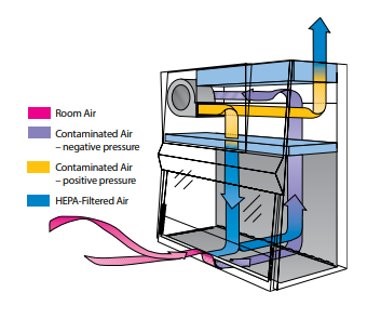
The PEC is the fume hood in which the compounding is performed, and the SEC is the cleanroom space in which the PEC is housed. The certifications by CETA are similar for both, with a few exceptions.
Primary Engineering Controls (PEC)
The PEC certification includes a visual test or smoke test to verify that the airflow at the opening to the BSC or fume hood is not too turbulent to draw the fumes out away from the hood, which could cause a hazard for the user compounding the drugs.
To help combat this issue, laminar flow diffusers with HEPA filters are recommended for use in the ceiling, and placement is critical to avoid drafts at the PEC openings.
Secondary Engineering Controls (SEC)
The certification of the SEC has several required tests and a few optional tests. Verifying the airflow quantity into and out of the cleanroom is required; measuring the airflow directly rather than calculating it based on the velocity is recommended. USP <797> and <800> provide minimum air changes per hour (ACH) for each type of space based on the ISO Classification.
Buffer rooms must be ISO Class 7 air quality or better. The actual compounding must be prepared in an ISO Class 5 or better PEC.
A PEC for hazardous drug compounding is a Biological Safety Cabinet (BSC) or a fume hood, with an exhaust connection, a recirculating fan, and a HEPA filter to increase clean air circulation. A PEC for non-hazardous drug compounding is a laminar flow hood or a fume hood that recirculates the room air after filtering it through a HEPA filter.
Ante rooms that serve as the access and aid control of the air shall be at least ISO Class 8. However, if the anteroom is access for a negative pressure buffer room, such as compounding hazardous drugs, it shall be at least ISO class 7.
To verify the ISO Class of the SEC, the CETA certification guide provides parameters for measuring the airborne total particle count. For reference, an ISO Class 8 space requires less than 3,520,000 particle counts per meter cubed of particles less than 0.5 microns measured under dynamic conditions, and USP <797> requires an air exchange rate of more than 20 ACH.
A better air quality space, such as an ISO Class 7, must have less than 352,000 particles per meter cubed with more than 30 ACH supply air.
Negative pressure rooms have greater exhaust flow rates. USP <797> focuses on air change rates being sufficient to dilute and remove airborne contaminants and thus considers supply air, not exhaust or return, to ensure dilution.
Room pressurization verification is also a required test, and the pressure gauges installed are required to be verified for accuracy with each certification. CETA discusses the procedure for the tests and the accuracy and resolution of the calibrated manometer required to be utilized.
Along with pressure, the temperature and relative humidity are required to be verified to be within the ranges listed and meet the owner’s requirements, and the sensor accuracy is to be verified every 12 months.
As discussed in the previous section, microbial air and surface sampling should occur if the space is outside designated parameters for an extended period.
The last required test is verifying that there is no supply air leakage around the HEPA filters in the laminar flow diffusers. CETA lists the procedure to use an aerosol medium and an aerosol photometer for testing the filters but cautions that if the room has smoke detectors, disable them first, so there are no false alarms.
For newly constructed or renovated cleanrooms, CETA recommends these optional tests for the lighting to verify an acceptable level with the equipment in the room and to test that the noise level is not objectionable.
They list as an option to do a room recovery rate test for troubleshooting by introducing particles and measuring how long the SEC takes to return to a steady state of cleanliness. They recommend this so that the users know how long of an outage to expect when an issue should arise, and the room needs to be cleaned.
Certification is a part of the final closeout when a pharmacy is under construction. Other closeout items related to the HVAC system are the testing, adjusting, and balancing (TAB) and the equipment commissioning.
Each of these items takes time and is challenging to perform concurrently; if you are scheduling a closeout of the construction of a pharmacy, be sure to leave time at the end of the project for the systems to be tested and set up properly. This process typically takes at least a month, but can extend longer depending on how well your team works together.
The pressure, temperature, humidity, contamination control, and certification requirements described throughout these sections are closely connected. Establishing the operating parameters with pharmacy and facility staff during design gives the project team a clearer basis for configuring controls, setting alarms, testing the space, and completing certification before occupancy.
If you are reviewing a current installation, planning a new compounding pharmacy, or considering a renovation, contact us to discuss the guidelines and lessons learned from the dozens of pharmacies we have designed.